How Much Does a Website Cost in 2026? A Real Pricing Guide for US, UK & Canada Businesses
If you've spent the last hour Googling "how much does a website cost" and gotten answers ranging from $200 to $200,000, you're not losing your mind — the range really is that wide. The reason is simple: "a website" isn't one product. A five-page brochure site and a custom ordering platform with a database, admin panel, and payment processing are both technically "websites," but they take a few days versus a few months to build.
This guide breaks down real 2026 pricing for businesses in the United States, United Kingdom, and Canada, what actually drives the cost up or down, and how to tell if a quote you've received is fair, inflated, or a red flag.
The Short Answer
For a small business in the US, UK, or Canada, expect to pay:
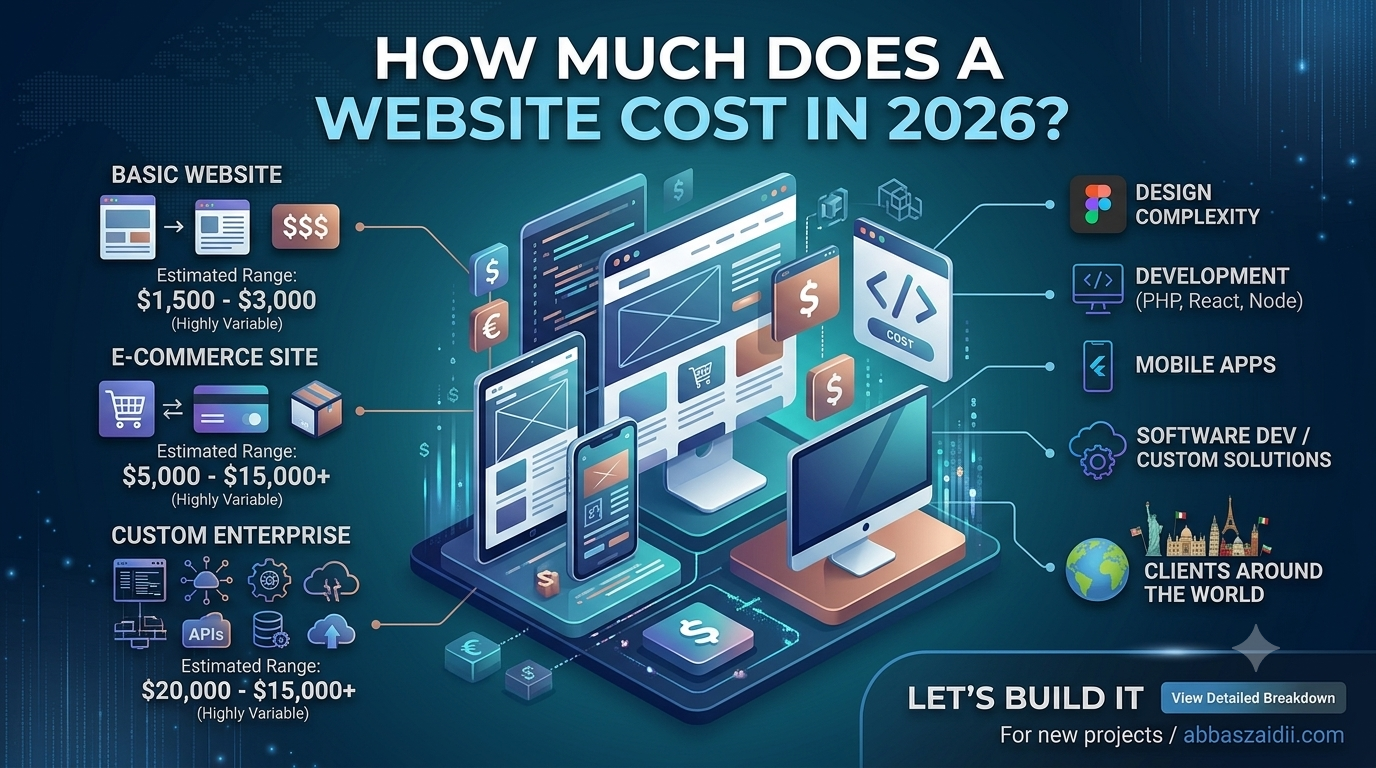
- Simple brochure/portfolio site (3–6 pages): $800 – $3,000 USD / £650 – £2,400 / CAD $1,100 – $4,000
- Business site with custom design + CMS (blog, case studies, contact forms): $2,500 – $8,000 USD / £2,000 – £6,500 / CAD $3,400 – $11,000
- E-commerce store: $4,000 – $15,000+ USD depending on catalog size and custom features
- Custom web application (ordering systems, booking platforms, dashboards, member portals): $8,000 – $40,000+ USD, sometimes more for complex logic or integrations
Agencies in London, New York, or Toronto typically sit at the top of these ranges — or above them — because of overhead. Experienced freelance developers who work directly with clients usually deliver the same (often better) quality at 30–60% less, because you're not paying for a project manager, an account exec, and an agency's office lease.
Why the Range Is So Wide: What Actually Drives Cost
1- Custom design vs. template
A site built from a page builder or theme (Squarespace, a WordPress theme, a Wix template) is cheaper because the visual design work is already done — you're just filling in content. A custom-designed site, where every layout, animation, and interaction is built specifically for your brand, costs more because someone is designing and coding it from a blank canvas. If your competitors all look the same, this is usually why — they used the same three themes.
2- Static site vs. dynamic backend
A static site (what you see is what's stored — no database) is fast and cheap to build. The moment you need user accounts, an admin panel to edit content without touching code, a database of products or bookings, or any kind of login system, you've moved into application territory. This is the single biggest cost driver, because it's not design work anymore — it's software engineering.
3- Number of custom features
Each of these adds real development time: a working contact form with spam protection, a blog with categories and a rich-text editor, e-commerce with inventory tracking, a loyalty/points system, multi-language support, appointment booking, payment gateway integration, or a client-facing dashboard.
4- Content and copywriting
Some quotes assume you're providing final text and images. Others include professional copywriting and photography, which adds cost but often matters more for conversions than the design itself.
5- Ongoing maintenance and hosting
A one-time build cost is only part of the picture. Hosting typically runs $10–$40/month for small business sites. If you want someone to handle updates, backups, and security patches, budget $50–$300/month depending on scope — or learn to do basic updates yourself if your CMS is built for it.
Real-World Example: What a Custom Platform Actually Costs
To make this concrete: a custom food-ordering web application — with a live product catalog, shopping cart, a loyalty points system, order management, and an admin dashboard — is the kind of project that typically falls in the $8,000–$20,000 range if quoted from scratch by an agency. Built by an experienced full-stack freelance developer who already has the underlying architecture (cart logic, database schema, admin tooling) refined from prior builds, the same scope can often be delivered for a fraction of that, with faster turnaround, because the developer isn't re-inventing the system every time — they're adapting a proven one.
This is the advantage of working with a developer who has actually shipped and operated real production systems, not just built portfolio demos.
Questions to Ask Before You Hire (Any Country)
Can I see live sites you've built, not just mockups?
Anyone can design a mockup. Ask for a URL you can click around on.
1- Who owns the code and the domain when it's done?
Get this in writing. Some cheap providers keep you locked into their hosting.
2- What's included after launch?
Bug fixes for 30 days? A year of updates? Nothing? Ask explicitly.
3- Is the CMS/admin panel something I can actually use?
A site you can't update yourself without paying for every text change isn't saving you money long-term.
4- What's the total cost, not just the deposit?
Some quotes look cheap upfront and add "necessary" extras later (hosting setup fees, SSL, "SEO package," etc.).
Red Flags That Signal Overpaying (or Underdelivering)
- A quote with no breakdown — just one flat number and no explanation of what's included
- Pressure to sign same-day for a "discount"
- No examples of live, working sites — only static images or PDFs
- Vague answers about who owns the final code
- A price that's dramatically below every other quote you've received, with no explanation of why
So, What Should You Budget?
If you're a small business, solo founder, or local service provider in the US, UK, or Canada wanting a professional site that actually converts visitors into customers, a realistic 2026 budget is $2,000–$6,000 for a custom-designed marketing site, or $8,000+ if you need a real application behind it (bookings, ordering, accounts, payments). Anything under $500 is almost always a template with your logo dropped in, and anything over $15,000 for a standard business site likely includes agency overhead you don't need.
Final Thought
The cheapest quote and the most expensive quote are both traps if you don't know what you're actually buying. The right question isn't "how much does a website cost" it's "how much does the website I actually need cost." Once you know whether you need a brochure site or a full application, the right price range becomes obvious, and so does whether a given quote is fair.
Looking for a straight answer on what your project would actually cost? I'm a full-stack developer who designs and builds custom sites and web applications from portfolio and business sites to live production platforms with admin panels, databases, and payment/ordering systems for clients in the US, UK, Canada, and beyond. Get in touch for a clear, no-pressure quote.
Frequently Asked Questions
Anyone can design a mockup. Ask for a URL you can click around on.
Get this in writing. Some cheap providers keep you locked into their hosting.
Bug fixes for 30 days? A year of updates? Nothing? Ask explicitly.
A site you can't update yourself without paying for every text change isn't saving you money long-term.
Some quotes look cheap upfront and add "necessary" extras later (hosting setup fees, SSL, "SEO package," etc.).